This article contains Amazon affiliate links. If you buy through them, I may earn a small commission at no extra cost to you. Amazonのアソシエイトとして、nihonshouhin.comは適格販売により収入を得ています。
I have used the same 6 kg top-load washer since 2018. It has no dryer, and I bought it because it was the cheapest machine in the shop: about ¥50,000-60,000 with delivery and installation. The same class costs less today, because Chinese makers and private brands such as Nitori, Iris Ohyama, Hisense and Midea have pushed prices down.
If I bought again, I’d choose a drum washer-dryer of 8-10 kg with heat-pump drying. This guide explains why, and why that is still the wrong machine for many people in a 1K.
Before any of that, measure. In a Japanese apartment the waterproof pan, tap height, drain position, door swing and the route from the front door can rule out a machine before price or features matter.
Top-load or drum washer-dryer
Japan sells two main families: 縦型 (tategata, top-load) and ドラム式 (doramu-shiki, drum-type).
A top-loader fills the tub with more water and moves clothes with a pulsator at the bottom. It is cheaper, lighter and simpler to maintain. Most people line-dry the laundry afterwards.
A drum machine lifts the clothes and drops them through a smaller amount of water. Most Japanese drum models also dry. That drying function is where most of the price difference sits.
Prices on kakaku.com for the week of 2026-10-05 to 10-11 show the gap clearly:
- Compact 7 kg top-load (Toshiba AW-7GM4): about ¥38,800
- 10 kg top-load (Panasonic NA-FA10K6): about ¥113,000
- 12 kg heat-pump drum (Panasonic NA-LX127EL, Toshiba TW-127XP5L): about ¥218,000-254,000
How much capacity do you need?
Panasonic, Hitachi, Sharp and AQUA use about 1.5 kg as one person’s laundry for one day:
- 1 person: about 1.5 kg per day
- 2 people: about 3 kg per day
- 4 people: about 6 kg per day
Treat this as the daily load, then add room for your routine. Panasonic recommends at least 1 kg of spare capacity for sheets and similar items. Someone who washes every day can use a smaller machine than someone who saves laundry for the weekend.
If you want the machine to dry, look at the drying figure, not the washing figure. On every model in the table below, the drying capacity is roughly half the washing capacity: 7 kg washes but 3.5 kg dries, 12 kg washes but 6-7 kg dries. That is why I’d look at 8-10 kg for a washer-dryer even though a 6 kg washer does the job for me today.
Heater drying vs heat-pump drying
This is the most expensive decision in the whole purchase, so it is worth understanding what is going on inside the drum.
A heater dryer works like a hair dryer. A fan pushes air over a heating element and blows hot air through the clothes. The moisture leaves the fabric, and the machine has to remove it from the air again. Most Japanese heater models do that with water-cooled dehumidifying (水冷除湿): tap water cools the air so the moisture condenses and drains away. The result is simple hardware, hotter air on the clothes, and more risk of shrinking fabrics that don’t like heat.
A heat-pump dryer works more like an air conditioner. A refrigerant circuit cools the damp air so the water condenses, then uses the same circuit to reheat the air before it goes back into the drum. Most of the heat gets recycled instead of thrown away. The air is cooler, which is gentler on fabric, and the electricity bill is lower. The cost is a more complex system of coils and piping, and that shows up in the price.
Here is what the makers’ own spec sheets say for a full wash-to-dry cycle:
| Model | Drying | Dry load | Time | Energy | Water |
|---|---|---|---|---|---|
| Panasonic NA-LX127EL (drum) | Heat pump | 6 kg | 98 min (eco 165) | 800 Wh (eco 620) | 55 L |
| Toshiba TW-127XP5L (drum) | Heat pump | 7 kg* | 87 min (energy-saving 215) | 1,330 Wh (energy-saving 670) | 61 L |
| Sharp ES-S7J (compact drum) | Heater | 3.5 kg | 170 min | 1,600 Wh | 80 L |
| Hitachi BW-DX100F (top-load) | Heater | 5.5 kg | 185 min | 1,980 Wh | 126 L |
Sources: Panasonic, Toshiba, Sharp and Hitachi spec pages, checked 2026-10-12. *Toshiba’s spec page doesn’t state the drying capacity; 7 kg is from retailer listings. Hitachi states its figures follow the Japan Electrical Manufacturers’ Association (JEMA) test standards. Real use varies with room and water temperature and the load.
At the 31 yen/kWh reference price used for appliance advertising in Japan, one wash-to-dry cycle costs about ¥19-41 on the heat-pump drums and about ¥50-61 on the heater machines. Per kilogram dried, the heater machines use roughly 2-4 times as much electricity.
Two things surprised me when I lined these numbers up. I had assumed heat pumps dry more slowly. In standard mode they were the fastest machines here, at 87-98 minutes against 170-185 minutes for the heater models. They only slow down in their eco modes, which roughly halve the energy again. The heater machines also use more water for a full cycle, because the water-cooled dehumidifying runs tap water the whole time the dryer is on.
So the trade-off is simple. A heat pump costs much more to buy and less to run. A heater drum is cheaper up front and costs more each time you dry. If you will dry most loads in the machine, the heat pump pays back faster. If you only dry in the rainy season, it may never pay back.
No dryer? How to dry laundry in a 1K
For one person in a 1K, I would still tell a friend to buy a 5-7 kg top-loader and skip the washer-dryer. It is cheaper, it fits more waterproof pans, and the drying problem has cheaper answers:
- A coin laundry dryer, if there is one nearby.
- The bathroom dryer (浴室乾燥機), if your bathroom has one.
- The aircon. I set it to 除湿 (dry) mode at 23°C during the rainy season and summer, and run a fan so air moves through the laundry.
- A dehumidifier. I don’t like high humidity, so I’d add one. Some models, such as Iris Ohyama’s IJD-I50 (a desiccant type), have a circulation fan built in, so one machine dries the room and moves the air. I haven’t owned that model; I came across it while researching drying for futon dryer development.
Measure before you order
I measured the waterproof pan (防水パン) and the tap height, and in my home both turned out to be fairly standard. The tighter constraint was getting the machine there.
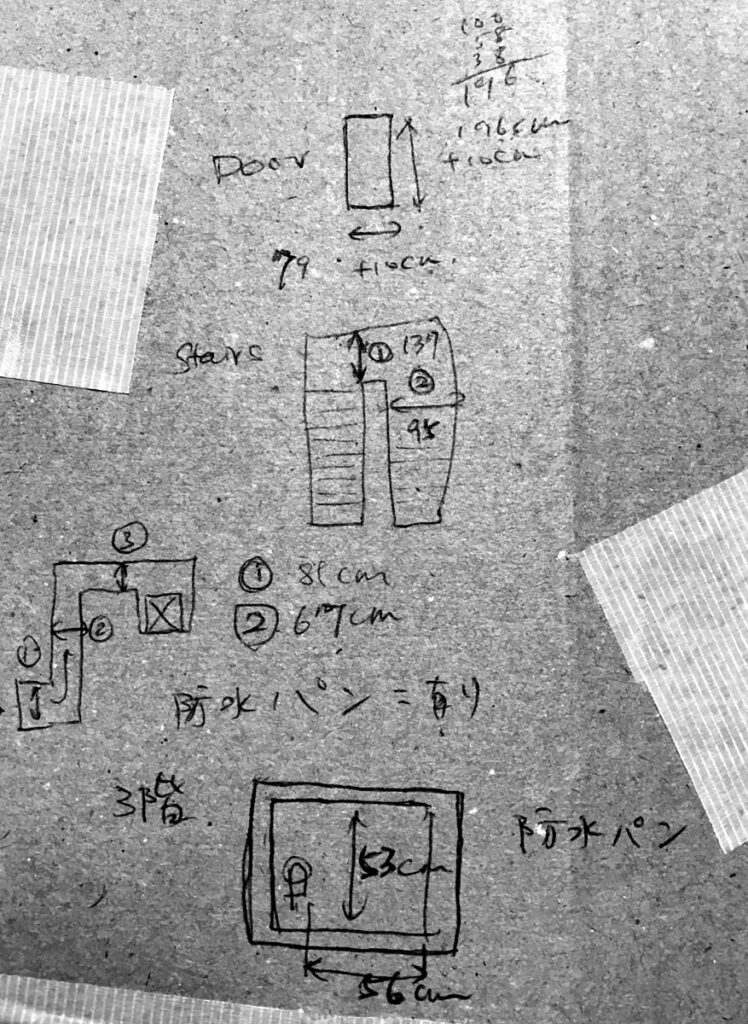
The laundry space is on the 3rd floor, up a flight of stairs, so I measured every width along the way, not just the pan. My door is 79 cm wide. For the machine itself I allowed about 10 cm of extra clearance so it could pass through without scraping.
That habit is the one I’d pass on: check the delivery path first. A machine can fit the pan and still be stuck at a door, a stair turn or a narrow corridor. The delivery company will usually phone you before delivery to confirm access, but by then you’ve already chosen the machine.
Measure these before ordering:
- The delivery path: front door, hallway, stairs or lift, and any tight turn
- The waterproof pan’s inner width and depth
- Tap height and space for the inlet hose
- Drain position and hose route
- Top-loader lid clearance, or drum door swing
- The 100 V outlet and earth (ground) connection
Use the full external dimensions, including hoses. Some makers also state a minimum pan size. Toshiba’s AW-7GM4 needs a pan with an inner depth of at least 540 mm, for example.
Door direction matters on a drum machine. Sharp sells the ES-S7J in left-opening and right-opening versions, and the door isn’t designed to be reversed after purchase.
Reading a Japanese spec sheet
Three figures show up on every Japanese washer spec sheet:
- 標準使用水量: standard water use per cycle, in litres.
- 消費電力量: energy per cycle, in Wh. This is the number for running cost.
- 運転音: noise in dB for washing, spinning and drying.
The makers measure these under standard test conditions, so I trust them for comparing one model against another. Your own loads, water temperature and installation will change the absolute numbers.
On noise: in most Japanese homes the washer sits in the room next to the bathroom (脱衣所), behind a door you can close, so the noise itself matters less. How much it matters depends on your neighbours.
I put an INABA DENKO ふんばるマン under my machine. It is a raised anti-vibration stand, sold as reducing the vibration that reaches the floor. My neighbour is sensitive to noise, and I have never had a complaint about the washer. I have had one about playing guitar with the windows open, which is a different problem.
Models to compare
Prices and stock checked on 2026-10-12.
Toshiba AW-7GM4 (7 kg top-load) for one or two people. It measures 555 × 560 × 990 mm including hoses, weighs about 33 kg, and needs a waterproof pan at least 540 mm deep inside. Toshiba lists 113 L of water and about 100 Wh per wash. It was number 4 in kakaku’s washing-machine ranking for 2026-10-05 to 10-11, at about ¥38,800. Spec: Toshiba AW-7GM4 page. Amazon had no direct offer on 2026-10-12, so it isn’t linked here.
Panasonic NA-FA10H6 (10 kg top-load) for larger households or anyone who washes once a week. It measures 592 × 628 × 1,024 mm including hoses and weighs about 40 kg. Panasonic lists 103 L of water and 50 Wh per wash at a 10 kg test load. It replaces the NA-FA10H5 this article recommended before, with the same water and energy figures. Spec: Panasonic NA-FA10H6 page. Check the Panasonic NA-FA10H6 on Amazon Japan (about ¥105,729 from a third-party seller on 2026-10-12)
Sharp ES-S7J (7 kg / 3.5 kg compact heater drum) for a small space where you still want one-button drying. About 598 mm wide (640 mm with the drain hose), 600 mm deep and 1,039 mm tall. A full wash-to-dry takes about 170 minutes and 1,600 Wh. It is a 2023 model, so compare its price with newer compact drums before deciding. Spec: Sharp ES-S7J page. Check the Sharp ES-S7J on Amazon Japan (about ¥139,500 on 2026-10-12)
Panasonic NA-LX127EL (12 kg / 6 kg heat-pump drum) for a family, or for anyone who will dry most loads in the machine. Panasonic lists 98 minutes and 800 Wh for a standard wash-to-dry, or 165 minutes and 620 Wh in eco mode. It was number 1 in kakaku’s ranking for 2026-10-05 to 10-11, at about ¥254,000. It is a large machine, so check the dimensions against your pan and delivery path. Panasonic lists it at 604 × 722 × 1,011 mm. Spec: Panasonic NA-LX127EL page. On 2026-10-12 Amazon only listed it at ¥315,810 from a third-party seller, well above the kakaku price, so it isn’t linked here.
Budget for disposal
Washing machines fall under Japan’s Home Appliance Recycling Law. Disposal normally involves 2 separate charges: the manufacturer’s recycling fee and the retailer’s collection and transport fee.
As of April 2026, the official recycling table lists washing-machine fees from ¥2,530 to ¥3,300 depending on the manufacturer. Collection and transport are charged separately by the retailer or local service. Ask for the total removal price when ordering a replacement.
METI explains the process in its Home Appliance Recycling Law guidance. The current manufacturer fees are listed by the Home Appliance Recycling Ticket Center.
When a retailer delivers a new machine, arranging removal at the same time is usually the easiest route. A private second-hand seller won’t normally handle your eventual disposal, so keep that future cost in the budget.
If you’re furnishing an empty apartment, the same measuring problem comes up with fridges and air conditioners. I covered those in what size fridge fits a Japanese apartment and my guide to buying an air conditioner.
Quick questions
Is a washer-dryer worth it in a 1K? Usually not. A 5-7 kg top-loader plus a coin dryer, bathroom dryer or dehumidifier costs far less, and fits more waterproof pans. A washer-dryer makes sense when you have no hanging space, dry most loads, and have checked that the machine fits the pan and the delivery path.
Heat pump or heater? Heat pump, if you’ll dry often and can afford it. On the spec sheets above, heat-pump drums used roughly half the electricity of heater machines while drying more laundry, and in standard mode they were faster. A heater drum is the budget option for occasional drying.
Can I use gel-ball detergent pods? Check both the detergent packet and the machine manual. Pod instructions commonly tell you to place the pod in the empty drum before adding clothes. Keep pods out of an automatic liquid-detergent dispenser unless the manufacturer explicitly permits them.
Can I bring a washing machine from another country? Japanese homes use 100 V power, with 50 Hz in eastern Japan and 60 Hz in western Japan. Voltage, frequency, plug, grounding, plumbing, delivery size and service support all need to match. Buying a Japanese-market machine is usually the safer and cheaper route.
Can I reverse a drum-machine door? Assume the answer is no unless the manual says otherwise. Choose the left-opening or right-opening version before ordering.
The short version
One person in a 1K: a 5-7 kg top-loader, and dry with a coin dryer, the bathroom dryer, the aircon’s dry mode or a dehumidifier.
A household that wants the machine to do the drying: choose by drying capacity, then pick heat pump over heater if the budget allows. It’s faster in standard mode and costs about half as much per cycle to run.
Everyone: measure the delivery path first, then the pan, then the tap.
Leave a Reply